![curbit-gr-no-tag@4x-1[2]](https://curbit.com/hs-fs/hubfs/curbit-gr-no-tag@4x-1%5B2%5D.png?width=150&height=39&name=curbit-gr-no-tag@4x-1%5B2%5D.png "curbit-gr-no-tag@4x-1[2]")
Let's be honest. Peak hours feel like survival mode.
Guests are pouring in. Delivery drivers are stacking up. The line is backed up. And your team is just trying to keep up without melting down.
If you’re leading ops at a multi-unit brand, you’ve probably lived this 1,000 times. And if you’re like most of the ops leaders we talk to, you’re asking:
“Why does it still feel this hard, even with all this tech in place?”
The answer? Most systems weren’t built to control your kitchen in real time. They track. They report. But they don’t orchestrate.
That’s why we built Curbit’s Goldilocks Zone, a system-level approach to fix the timing problem that breaks everything else.
And right now, with margins tight and digital orders rising fast, getting this right is more important than ever.
Timing isn’t just a kitchen issue, it’s a business issue.
When your kitchen fires too early, food sits. It goes cold. Drivers wait. Guests complain.
When you fire too late, orders run behind. Guests show up angry. Staff stress goes through the roof.
This isn’t about being “a few minutes off.” This is about how that timing mismatch ripples through your entire operation:
- Lower throughput during peak
- More labor wasted on reworks and remakes
- Refunds and bad reviews
- Drivers choosing not to pick up from you
- Guests who don’t come back
The worst part? Most teams are guessing when to fire and sequence orders. Because the systems you have today (POS, ordering, KDS) were never built to orchestrate timing dynamically.
That’s where Curbit comes in.
The Goldilocks Zone: Not Too Early, Not Too Late, Just Right
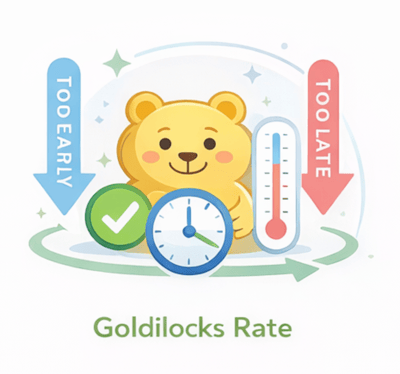 We define the Goldilocks Zone as the window — usually within ±2–4 minutes of the promised time — where the order is ready exactly when the guest or driver arrives.
This is the sweet spot where:
- Food’s hot and fresh
- No one is waiting
- The kitchen flows smoothly
Curbit dynamically adjusts when each order is fired based on real-time kitchen capacity, current workload, and guest arrival patterns.
So instead of “set it and forget it” timing rules or fire-by-feel guessing, you get live orchestration that adapts by the second.
What happens when you consistently hit the Goldilocks Zone:
1. You increase throughput without adding labor
When the kitchen isn’t backing up with early orders or constantly switching priorities, your line moves cleaner, faster, and with less stress.
Less chaos = more completed orders per hour.
In ops terms: Higher kitchen throughput with the same team, same space.
 2. You improve Revenue Per Kitchen Hour (RPKH)
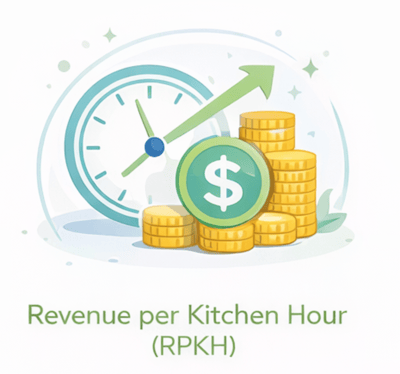
This is one of the most overlooked (but powerful) metrics in restaurant operations. RPKH = how much revenue you’re generating for every hour the kitchen is running. Read more about RPKH here.
Curbit customers typically see 10–15% improvements in RPKH within 90 days — just by improving timing.
Why? Because you’re:
- Doing more with the same labor
- Reducing idle time and wasted prep
- Keeping more orders in the digital queue because your timing stays tight
In a world where labor is expensive and every dollar counts, that’s real impact.
3. Guests and drivers are actually happy
We don’t just measure timing — we close the loop with real guest feedback right after every handoff.
We call this the Happy Handoff Rate — and it’s our fastest feedback signal.
When guests get hot food on time, they give thumbs up. When they wait or get cold food, they let us know. That data trains the system to get better every shift, every store.
High Goldilocks Rate = High Happy Handoff Rate = Better reviews, better retention, and fewer headaches.
 Why now? Because the market won’t wait.
We’re in a moment where:
- Digital orders are exploding (many brands pushing 40–60% off-prem)
- Margins are tighter than ever
- Labor is scarce and expensive
- Guests have zero patience for bad handoffs
If you’re still relying on static rules, gut feel, or legacy throttling systems to control your digital order flow, you’re leaving revenue (and sanity) on the table.
You already have the tools. Curbit makes them work together.
We’re not here to replace your POS, KDS, or ordering platform. We’re the orchestration layer that connects them and gives you real-time control over what’s happening in the kitchen.
Think of it like this:
Toast, Olo, PAR, CrunchTime = systems of record.
Curbit = real-time control system.
We sit between those systems and the kitchen line — making sure the right orders are fired at the right time, so every guest and driver gets a smooth, on-time handoff.
Bottom line?
If you’re leading operations and you’re judged on throughput, labor efficiency, guest satisfaction, and financial performance — the Goldilocks Zone should be your new favorite metric.
It’s the clearest signal of whether your kitchen is operating in control — or in chaos.
Ready to see your Goldilocks Rate?
Let’s talk. We’ll show you where your timing breaks down, how orchestration improves your flow, and what it looks like to run a kitchen that just works — even at peak. Book a demo