![curbit-gr-no-tag@4x-1[2]](https://curbit.com/hs-fs/hubfs/curbit-gr-no-tag@4x-1%5B2%5D.png?width=150&height=39&name=curbit-gr-no-tag@4x-1%5B2%5D.png "curbit-gr-no-tag@4x-1[2]")
Customers love the convenience of digital ordering. But when the execution breaks down, that loyalty disappears fast. Here's where things go wrong and how operators can fix it.
Online ordering has fundamentally changed how people eat. The convenience is real, the growth is undeniable, and for most restaurant brands today, digital channels represent a significant and growing share of total revenue. It's easy to understand why customers prefer ordering online — no lines, no pressure, full control over the experience.
But here's the part that doesn't make it into the marketing decks: a lot of those orders are quietly disappointing people. Not in dramatic, obvious ways. In the small, friction-filled ways that erode trust, tank ratings, and quietly push guests toward a competitor the next time they're hungry.
The good news is that most of these failure modes are fixable. Let's walk through the most common ones.
 1. The Quote Time Was Wrong
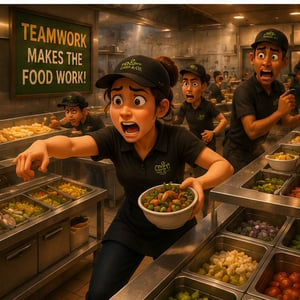
Nothing sets up disappointment faster than an inaccurate promise. When a guest places a pickup order for 6:15 and shows up at 6:15 to find their food hasn't been started, the trust is broken before they even open the bag.
Most restaurants are quoting static or manually-inflated times that have no relationship to what the kitchen is actually doing in that moment. The order volume, the ticket mix, the staff on the line, none of that is being factored in. It's a guess, and guests know it.
Real-time quote accuracy is the foundation of a good digital experience. Without it, everything else is downstream damage control. And there's a real cost beyond guest experience, inflated quote times can also suppress your restaurant's visibility on third-party delivery platforms, costing operators tens of thousands in lost sales annually.
2. The Food Sat Too Long Before Pickup
The order was done in 14 minutes. The guest arrived 22 minutes after placing the order. By the time the bag was in their hands, the fries were cold and the sandwich had steamed through the wrapper.
This has happened to everyone.
This is one of the most common (and most silent) sources of online ordering disappointment. The kitchen hit its number. The order was ready. But there was no coordination between when the food was done and when the guest or driver would arrive to claim it.
This is the food dwell time problem, and it's a direct function of poor order orchestration. Getting timing right isn't just about speed — it's about synchronization.
 3. The Lobby Was Packed With Waiting Drivers
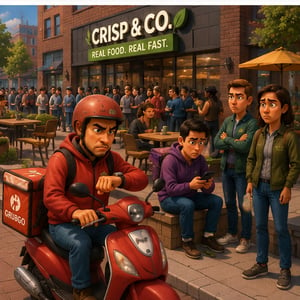
Picture this: a guest walks in to grab their order and finds six delivery drivers milling around the lobby, all waiting on food. The whole experience feels chaotic. Even if their order is ready and waiting on the shelf, the environment signals that this operation is out of control.
Driver congestion at pickup is a symptom of orders not being sequenced correctly — food is firing before drivers are close, creating a bottleneck at the front of the house. It's a guest experience problem disguised as an operations problem.
4. There Was No Communication After the Order Was Placed
Guests place an order and then... nothing. No update. No ETA refinement. Just a waiting game until they decide to show up and hope for the best.
In an era where consumers track their Amazon packages in real time and watch their Uber driver navigate a grid, radio silence after placing a food order feels like neglect. Even a single proactive message — "your order is being prepared and will be ready at 6:22" — changes the emotional experience completely.
Accurate, timely guest communication turns a transactional interaction into a hospitality moment. It's one of the most underdeveloped opportunities in restaurant digital operations.
5. The Order Was Wrong
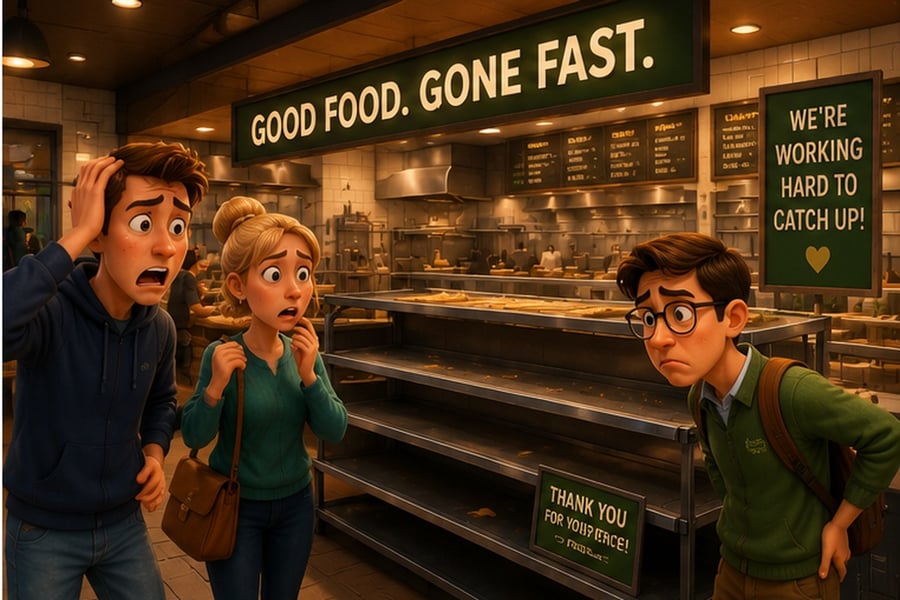
This one is obvious but worth naming because it's often a timing problem masquerading as an accuracy problem. When kitchens are overwhelmed, ticket errors spike. Items get missed. Modifications get skipped. The team is moving too fast to catch it.
Kitchen capacity management isn't just about throughput — it's about protecting accuracy under pressure. A kitchen that's been properly paced makes fewer mistakes. That means fewer remakes, fewer refunds, and fewer one-star reviews with the words "missing item" in them.
6. The Pickup Experience Felt Like an Afterthought
The digital ordering channel got a lot of investment: the app is polished, the menu photos look great, the checkout flow is smooth. Then the guest arrives, can't find where to pick up their order, stands at the counter waiting to be acknowledged, and eventually gets handed a lukewarm bag with no eye contact.
The physical pickup experience is the last mile of the digital promise. It's where the technology meets the hospitality, and for a lot of brands, there's a visible gap. A well-timed, well-organized Happy Handoff® is the moment that earns the next order.
7. The Wait Was Longer Than Dining In Would Have Been
This is the one that really stings. A guest chose digital ordering specifically because they didn't want to wait. If the total experience — placing the order, arriving at the quoted time, waiting for the food to actually be ready — ends up taking longer than just walking in and ordering at the counter, the value proposition has completely collapsed.
Online ordering is supposed to trade kitchen time for guest wait time. When the kitchen isn't synchronized with the channel, that trade never happens.
8. Peak Hours Broke the Experience
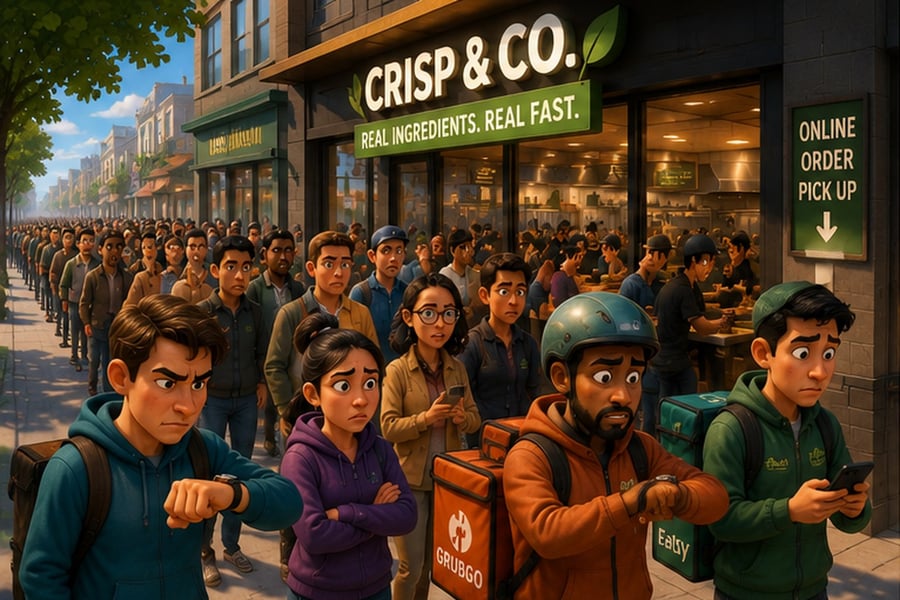
Everything worked fine on a Tuesday at 2pm. But Friday at 6pm was a different story. The quote times stretched, the orders backed up, the lobby filled, and the kitchen went into survival mode.
Peak-hour performance is where digital ordering promises either get kept or get broken. The restaurant that looks great on a slow night and falls apart at peak is the restaurant losing its best customers — the ones who order regularly, tip well, and tell people about their experiences.
Managing the omnichannel surge during peak demand requires more than good people working hard. It requires real-time visibility and dynamic controls that no POS or ordering platform was built to provide.
9. A Bad Experience Never Got Addressed
The guest left disappointed. They didn't call. They didn't fill out a survey. They just didn't order again — and three weeks later they left a two-star Google review that mentioned "cold food" and "long wait."
Most restaurants don't have a mechanism to identify the orders that went wrong before they become reviews. The data exists in the kitchen — it's in the gap between when an order was supposed to be ready and when it actually was, in the dwell time on the shelf, in the driver wait times. Surfacing that data is the first step toward recovery.
10. Nothing Changed After the Bad Review
A guest left negative feedback. Maybe they rated the order one star in the app. Maybe they left a Google review. And the restaurant... moved on. No response. No follow-up. No visible signal that anyone cared.
For digital guests, a non-response to a complaint is confirmation that the relationship wasn't real. Brands that close the loop — even with a simple acknowledgment and a gesture toward making it right — recover those customers at a dramatically higher rate than those that don't.
The Pattern Behind All of It
Read through that list and one thread runs through nearly every failure mode: the kitchen and the guest weren't synchronized. The food was done before the driver arrived, or the guest arrived before the food was done, or no one communicated what was happening in between.
That's the core of the online ordering experience problem. It's not a menu problem or a staffing problem or even an app problem. It's an orchestration problem — and it's solvable!
Curbit was built specifically to close this gap. By reading live kitchen data from your KDS and connecting it to your ordering platforms in real time, Curbit dynamically manages quote times, sequences orders intelligently, and ensures guests and drivers arrive when the food is actually ready — not before, not after. The result is what we call the Goldilocks Zone®: every order ready at exactly the right moment, every shift, at every location.
-
Brands using Curbit see up to a 30–40% improvement in on-time order readiness, a 10–20% lift in repeat rates, and an average improvement of 0.54 stars on Google ratings.
The guests are already choosing digital. The question is whether the execution earns them back.
Ready to See What's Happening in Your Kitchen?
Curbit's fleet assessment gives operators a clear, data-driven look at where digital orders are succeeding — and where the experience is quietly breaking down. No new hardware. No staff retraining. Just visibility, and a path to fixing it.